Welcome to Bennett's Study

From the Author of No Land an Island and Unconscionable

Pondering Alphabetic SOLUTIONS: Peace, Politics, Public Affairs, People Relations

http://www.bennettponderingpeacepoliticssolutions.com/

http://www.bennettponderingpeacepoliticssolutions.com/author/

http://www.bennettponderingpeacepoliticssolutions.com/buy/

UNCONSCIONABLE: http://www.unconscionableusforeignrelations.com/ http://www.unconscionableusforeignrelations.com/author/ http://www.unconscionableusforeignrelations.com/book/ http://www.unconscionableusforeignrelations.com/excerpt/ http://www.unconscionableusforeignrelations.com/contact/ http://www.unconscionableusforeignrelations.com/buy/ SearchTerm=Carolyn+LaDelle+Bennett http://www2.xlibris.com/books/webimages/wd/113472/buy.htm http://www.prweb.com/releases/2014/08UNCONSCIONABLE/prweb12131656.htm http://bookstore.xlibris.com/AdvancedSearch/Default.aspx? http://bookstore.xlibris.com/Products/SKU-000757788/UNCONSCIONABLE.aspx

http://todaysinsight.blogspot.com

Showing posts with label women's rights. Show all posts

Sunday, March 24, 2013

Profiteers at counter purposes with human need peddle cells, not privies

Sudanese woman
carries water home

Baffling (or is it?): Why Third World under-developing countries remain underdeveloped ─ or worse
Re-reporting, editing, brief comment by 
Carolyn Bennett

Canon of profiteers: profit at all costs holds back human progress

S
ix billion of the world’s seven billion people have mobile phones. But only 4.5 billion have access to toilets or sanitary latrines, the United Nations reported on World Water Day March 22. 

Woman in Northern India
bathes at public pump
Dehumanizing human beings

Some 2.5 billion people, mostly in rural areas of Asia and Africa, have no access to proper sanitation. In the twenty-first century, 1.1 billion people have no choice but to defecate in the open.

“Let’s face it,” UN Deputy Secretary-General Jan Eliasson says, “this is a problem that people do not like to talk about. But ─

It goes to the heart of ensuring good health, a clean environment and fundamental human dignity for billions of people – and achieving the Millennium Development Goals.


R
eview: the eight UN Millennium Development Goals for 2015:

1. Eradicate extreme poverty and hunger
2. Achieve universal primary education
3. Promote gender equality and empower women
4. Reduce child mortality
5. Improve maternal health
6. Combat HIV/AIDS, malaria and other diseases
7. Ensure environmental sustainability
8. Develop a global partnership for development

Woman seeks water
from karez at
Piskandi Village
Northern Iraq
Developing countries never develop

But nearing 2015, countries of South Asia and sub-Saharan Africa, some 20 countries, account for more than 80 percent of the global problem of open defecation. These countries have the 
  • Highest incidence of death among the under-five-year-olds;
        • High levels of malnutrition and poverty; and
      • Large disparities in wealth

Women and girls are hardest hit. Lack of sanitation is particularly detrimental to women and girls, the UN reports. Women and girls who have to leave their homes to find a place to urinate or defecate are vulnerable to sexual violence. The lack of toilets in schools impedes girls’ access to education.

What if corporate canon changed?

The head of one non-governmental organization, WaterAid, which focuses on water and sanitation, said, “Few interventions would have greater impact on the lives of women and girls than addressing the health problems caused by poor sanitation and hygiene.”

Little girls carrying watercross rice field
after heavy rains
The United Nations says investing in good sanitation is a good investment. Such investment “produces a good return: Every dollar spent on sanitation brings a $5.50 return by keeping people healthy and productive.”

A
pproaching 2015, the United Nations reports, however, that the target in the MDGs of at least halving the proportion of people without access to sanitation ─ and this is a small order, achievable but for countering profit motives  ─ has “far to go.”

This means that the goal will not be achieved without a change in ethos and canon, political will, change of heart. A conviction that all of us are Africa and Asia and their well-being is our well-being,  that we are not islanded and apart. 
Delivering water in
Sudan

No land an island no people apart.


Surely, I am not the only person who believes this ─ that we can do better if we alter the course of our thinking and acting, our sense of being among peoples coexisting in world society. I think the United Nations tries in a variety of special days, celebrations and conferences to help us sense this “oneness.”

This year has been designated “International Year of Water Cooperation.” Friday March 22 was “World Water Day.”


Sources and notes

“More people have mobile phones than toilets – UN” (AlertNet, Lisa Anderson), March 22, 2013, http://www.trust.org/alertnet/news/more-people-have-mobile-phones-than-toilets

UN Millennium Development Goals

In September of the year 2000, leaders of 189 countries met at the United Nations in New York and endorsed the Millennium Declaration, a commitment to work together to build a safer, more prosperous and equitable world.

The Declaration was translated into a roadmap setting out eight time-bound and measurable goals to be reached by 2015, known as the Millennium Development Goals

Eight UN Millennium Development Goals for 2015

1. Eradicate extreme poverty and hunger
2. Achieve universal primary education
3. Promote gender equality and empower women
4. Reduce child mortality
5. Improve maternal health
6. Combat HIV/AIDS, malaria and other diseases
7. Ensure environmental sustainability
8. Develop a global partnership for development

http://www.undp.org/content/undp/en/home/mdgoverview.html
For more information, please visit: www.un.org/millenniumgoals
http://www.un.org/en/mdg/summit2010/pdf/List%20of%20MDGs%20English.pdf

The United Nations reports that the Millennium Development Goal of halving the proportion of people without access to improved sources of water has been met but

The target to halve the proportion of people without access to sanitation still has “far to go.”

A call to action issued by U.N. Deputy Secretary-General Jan Eliasson aims at a 2025 goal of improving hygiene, better managing of   human waste and waste-water, and eliminating the practice of open defecation.

“Ending open defecation,” says United Nations Children’s Fund (UNICEF) deputy executive director Marin Mogwanja, “will contribute to a 36 percent reduction in diarrhea,” a condition that kills three quarters of a million under-five-year-old children every year.”
 
World Water Day March 22

World Water Day is held annually on March 22 as a means of focusing attention on the importance of freshwater and advocating for the sustainable management of freshwater resources.

An international day to celebrate freshwater was recommended at the 1992 United Nations Conference on Environment and Development (UNCED).  The United Nations General Assembly responded by designating March 22, 1993, as the first World Water Day.

E
ach year, World Water Day highlights a specific aspect of freshwater. In 2013, in reflection of the International Year of Water Cooperation, World Water Day is also dedicated to the theme of cooperation around water and is coordinated by UNESCO in collaboration with UNECE and UNDESA on behalf of UN-Water. http://www.unwater.org/water-cooperation-2013/events/world-water-day/en/

2013 International Year of Water Cooperation

In December 2010, following the proposal initiated by Tajikistan [a country lying in the heart of Central Asia, bordered by Kyrgyzstan on the north, China on the east, Afghanistan on the south, and Uzbekistan on the west and northwest] and submitted by a group of countries, the United Nations General Assembly declared 2013 ─  the United Nations International Year of Water Cooperation (Resolution A/RES/65/154).

T
he United Nations Educational, Scientific and Cultural Organization (UNESCO) was appointed by UN-Water to lead the preparations for both the 2013 International Year of Water Cooperation and the World Water Day, in collaboration with the United Nations Economic Commission for Europe (UNECE) and with the support of the United Nations Department of Economic and Social Affairs (UNDESA), the UN-Water Decade Program on Capacity Development (UNW-DPC) and the UN-Water Decade Program on Advocacy and Communication (UNW-DPAC).

UN-Water called upon UNESCO to lead the 2013 International Year of Water Cooperation in view of the organization’s multi-dimensional mandate in the realm of natural and social sciences, culture, education and communication, and its significant and long-standing contribution to the management of the world’s freshwater resources. http://www.unwater.org/water-cooperation-2013/water-cooperation/en/

IMAGES
http://www.flickr.com/photos/unworldwaterday/8476002418/

UNESCO Béatrice Petit, Aerial view of Assouan dam Egypt water coop 2013

© Dale Lightfoot, 2010, Woman seeking water from the karez at Piskandi Village in northern Iraq....
© UN Photo/Milton Grant, A young woman pumps water from a well in the lowlands area of Eritrea.
© UN Photo/Tim McKulka, A Sudanese woman carries water home in a plastic container.
Delivering water in Sudan - All rights reserved, Uploaded on Feb 15 2013
© Kate Holt: During the drought last year many people died. Eyanai, a young boy, et.al  ...
UN Photo/Martine Perret, Little girls cross a rice field after heavy rains carrying water in plastic containers.


________________________________________

Bennett's books are available in New York State independent bookstores: Lift Bridge Bookshop: www.liftbridgebooks.com [Brockport, NY]; Sundance Books: http://www.sundancebooks.com/main.html [Geneseo, NY]; Mood Makers Books: www.moodmakersbooks.com [City of Rochester, NY]; Dog Ears Bookstore and Literary Arts Center: www.enlightenthedog.org/ [Buffalo, NY]; Burlingham Books – ‘Your Local Chapter’: http://burlinghambooks.com/ [Perry, NY 14530]; The Bookworm: http://www.eabookworm.com/ [East Aurora, NY] • See also: World Pulse: Global Issues through the eyes of Women: http://www.worldpulse.com/ http://www.worldpulse.com/pulsewire http://www.facebook.com/#!/bennetts2ndstudy

________________________________________

Friday, June 8, 2012

For once, let a woman stand, be heard on issues of substance


Elizabeth Warren
Stop attempt to bring her down
By Carolyn Bennett

On Saturday, despite the mass distraction, Consumer advocate and academic Elizabeth Warren of Massachusetts won the Democratic nomination to challenge U.S. Senator Scott Brown. The Christian Science Monitor asked in its Sunday headline, “Has she put the ‘Cherokee issue’ behind her?” Well, I expect she could if the press and Co would.

What really is at issue here is a media manufactured “Native American-Elizabeth Warren attack issue,” a ploy played out for the masses, a ridiculous waste of ink and air. 

This yammering on a non issue from sources who could care less about Native Americans says less about Elizabeth Warren than it does about the U.S. (male mostly) obsession with race and racialism and the malicious use of this card in government and politics, in ivory towers and corporations including media organizations, from rank and file to board rooms; and the needless struggle women and minorities shoulder throughout their lives because of it. 

If there is outrage here, it rests with the peddlers of an insidious attack on and undermining of women and minorities and their aspirations.  

According to the latest Western New England University poll of registered voters, the Monitor reports, Warren leads Brown 45-43 percent (within a 4.4-point margin of error).

For once, let a woman stand and be heard on the substantive issues she puts forth and win or lose on her own arguments, her own credentials, her own demonstrated qualifications, her own character without hurling stupidities, divisiveness, distractions aimed at tarnishing her personally and weakening her drive. 

There is no burning cross or blue dress here, so give it a rest. 


Sources:
“Has Elizabeth Warren put the ‘'Cherokee issue’ behind her? Elizabeth Warren has won the Democratic nomination to challenge US Senator Scott Brown in Massachusetts. But questions about her claim to Native American ancestry continue to dog her.” Brad Knickerbocker, Staff writer / June 3, 2012 at Christian Science Monitor, http://www.csmonitor.com/USA/Elections/Senate/2012/0603/Has-Elizabeth-Warren-put-the-Cherokee-issue-behind-her

“Elizabeth Warren’s Native American fiasco: Campaign killer? The Democrat challenging Sen. Scott Brown admits for the first time that she did indeed tell her employer about her now-disputed Cherokee ancestry” posted on June 1, 2012, http://www.csmonitor.com/USA/Elections/Senate/2012/0603/Has-Elizabeth-Warren-put-the-Cherokee-issue-behind-her

____________________

Bennett's books are available in New York State independent bookstores: Lift Bridge Bookshop: www.liftbridgebooks.com [Brockport, NY]; Sundance Books: http://www.sundancebooks.com/main.html [Geneseo, NY]; Mood Makers Books: www.moodmakersbooks.com [City of Rochester, NY]; Dog Ears Bookstore and Literary Arts Center: www.enlightenthedog.org/ [Buffalo, NY]; Burlingham Books – ‘Your Local Chapter’: http://burlinghambooks.com/ [Perry, NY 14530]; The Bookworm: http://www.eabookworm.com/ [East Aurora, NY] • See also: World Pulse: Global Issues through the eyes of Women: http://www.worldpulse.com/ http://www.worldpulse.com/pulsewire http://www.facebook.com/#!/bennetts2ndstudy

________________________________

Tuesday, May 8, 2012

Rocky Anderson campaign backs one nation indivisible, ERA


Liberty denied for any
Liberty denied for all
Editing, excerpting by Carolyn Bennett
From RA’s “War on Women” speech
From National Council of Women’s Organizations’ ERA notes

In this together

“Our nation is facing a dangerous onslaught of bigoted, authoritarian policies and practices pushed not only by extremist right-wing groups of fanatics but by people (including Republicans and Democrats)  who are generally thought to be more mainstream,” U.S. presidential candidate Rocky Anderson said in his April 28 campaign speech.

For the first time in our history, he said,  we have Legislative and Executive branches of government enacting laws permitting the president —in the manner of tyrants — to target anyone: U.S. citizens to be kidnapped, disappeared, held incommunicado indefinitely in military prisons without charge, trial, legal assistance, without the right of habeas corpus.

Under LAW
Writ of Habeas Corpus (review)

The Writ of Habeas Corpus is an ancient common-law writ issued by a court or judge directing one who holds another in custody to produce the body of the person before the court for some specified purpose. The most important variety of the writ is that used to correct violations of personal liberty by directing judicial inquiry into the legality of a detention.

In the British colonies in North America, by the time of the American Revolution, the rights to habeas corpus were popularly regarded as among the basic protections of individual liberty. The U.S. Constitution guarantees that the privilege ‘shall not be suspended, unless when in cases of rebellion or invasion the public safety may require it.’

United States (current law)

Under 20th century U.S. Supreme Court interpretation of the constitutional rights, people accused of crime or prisoners may file habeas corpus petitions challenging their   convictions.

We the people
Enlightened
Indivisible
Under law
A writ frequently is requested on behalf of a person in police custody for the purpose of requiring the police to either charge the arrested person with an offense or release him.

Habeas corpus proceedings may be employed to obtain release of the accused prior to trial on the ground that the bail set is excessive.

In cases of a person arrested on a warrant of extradition, a proceeding in habeas corpus may be instituted to challenge the validity of the warrant.


“Our nation is being transformed,” Anderson says; “our Republic is being undermined.” Human rights, rights under law, women’s rights are being denied.

  
Women

Vicious attacks on women, Anderson says, are part of the undoing of fundamental principles of equality and justice. 

In the states of Utah, Kansas, Arizona, Georgia, South Dakota, Virginia and others, officials have taken outrageous actions that invade the privacy and personal being of women, that threaten healthcare professionals and health services providers, that deny homes to adoptable children, and that criminalize what should be protected rights as a matter of law and consistent with the Universal Declaration of Human Rights.

The attacks on women compel that we fulfill the unmet, urgent imperative — “this time a successful fight” — to legislate and ratify and secure in the Constitution of the United States the “Equal Rights Amendment.”


ERA (review)

Suffragist leader Alice Paul
In its first introduction the Equal Rights Amendment was considered the next necessary step after ratification of Woman Suffrage, the 19th Amendment affirming women’s right to vote — guaranteeing ‘equal justice under law’ to all citizens.

The Equal Rights Amendment was written in 1923 by suffragist leader Alice Paul, founder of the National Woman’s Party. Its text is simple and straightforward.
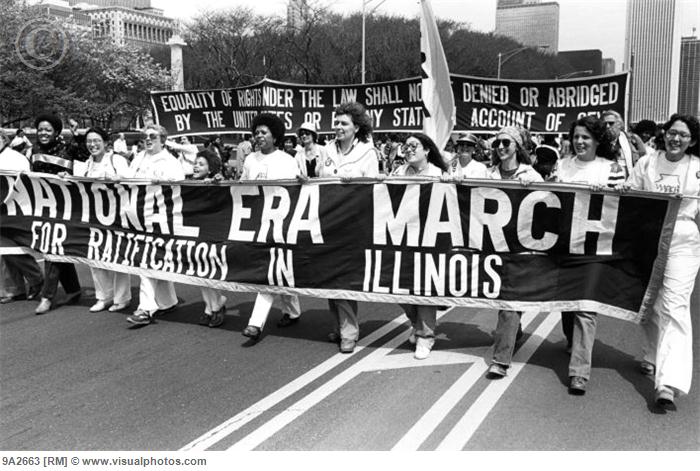
Section 1: Equality of rights under the law shall not be denied or abridged by the United States or by any state on account of sex.
Section 2:  The Congress shall have the power to enforce, by appropriate legislation, the provisions of this article.
Section 3: This amendment shall take effect two years after the date of ratification.
After its1923 proposal and introduction in the Congress of the United States, the Equal Rights Amendment “was introduced into every session of Congress between 1923 and 1972, when it was passed and sent to the states for ratification.  The seven-year time limit in the ERA’s proposing clause was extended by Congress to June 30, 1982. At the deadline, the ERA had been ratified by 35 (short three) of the required 38 states for ratification. Since that time, the amendment has been reintroduced in every session of the U.S. Congress.

U.S. Congresswoman 
Carolyn Maloney
2011
In the 110th Congress (2007 - 2008), the Equal Rights Amendment was introduced as S.J. Res. 10 (Sen. Edward Kennedy, Massachusetts, lead sponsor) and H.J. Res. 40 (Rep. Carolyn Maloney, New York, lead sponsor). In the 112th Congress (2011-2012) are S.J. Res. 21 (lead sponsor Sen. Robert Menendez, D-New Jersey) and H.J. Res. 69 (lead sponsors Rep. Carolyn Maloney, D-New York, and Rep. Judy Biggert, R-Illinois).
On March 8, 2011, Rep. Tammy Baldwin (D-Wisconsin) introduced H.J. Res. 47, which would remove the ERA’s ratification deadline and make it part of the Constitution when three more states ratify. The Senate companion bill, S.J. Res. 39, was introduced on March 22, 2012, by Sen. Benjamin Cardin (D-Maryland). To add the ERA to the U.S. Constitution requires passage of the bills by a two-thirds vote in each house of the U.S. Congress and ratification by 38 states.


The National Council of Women’s Organizations has outlined the imperative for ERA inscription into the Constitution of the United States.
Without the ERA, the Constitution does not explicitly guarantee that the rights it protects are held equally by all citizens without regard to sex. The first – and still the only – right specifically affirmed as equal for women and men is the right to vote. 
The equal protection clause of the Constitution’s 14th Amendment was first applied to sex discrimination only in 1971, and it has never been interpreted to grant equal rights on the basis of sex in the uniform and inclusive way that the ERA would. 
The ERA would provide a clearer judicial standard for deciding cases of sex discrimination, since federal and state courts (some working with state ERAs, some without) still reflect confusion and inconsistency in dealing with such claims. It would also clarify sex discrimination jurisprudence and 40 years of precedent for Supreme Court Justice Antonin Scalia, who claimed in an interview reported in the January 2011 California Lawyer that the Constitution, specifically the 14th Amendment, does not protect against sex discrimination. 
Suffragist march 1917
The ERA would provide a strong legal defense against a rollback of the significant advances in women’s rights made in the past 50 years. 
Without it, Congress can weaken or replace existing laws on women’s rights, and judicial precedents on issues of gender equality can be eroded or ignored by reactionary courts responding to a conservative political agenda. 
Without the ERA, women regularly and men occasionally have to fight long, expensive, and difficult legal battles in an effort to prove that their rights are equal to those of the other sex. 
The ERA would improve the United States’ human rights standing in the world community. The governing documents of many other countries affirm legal gender equality, however imperfect the global implementation of that ideal may be.

One nation, indivisible, with liberty and justice for all

Ending his “War on Women” speech, Rocky Anderson says, “All of us are at risk” and together we must stand. Take sustained action. Make clear that these abuses will not stand.

“Equality and justice are not just catch phrases,” he says. “Equality and justice must continue to define what America stands for and what we the American people will continue to fight for.  It is up to each and all of us together — united in our purpose — to stand and fight tenaciously for the rights and liberties of all.”


Sources and notes

“War on Women Rally” Remarks of Ross C. (Rocky) Anderson, Utah State Capitol
April 28, 2012,
http://www.voterocky.org/war_on_women_speech?utm_campaign=equality_more&recruiter_id=67772&utm_medium=email&utm_source=voterocky

National Council of Women’s Organizations, 714 G Street, SE, Suite 200, Washington, DC 20003 202-293-4505, (fax) 202-293-4507, ncwo@ncwo-online.org,  ww.womensorganizations.org
ERA Task Force (Roberta W. Francis, Chair): era@equalrightsamendment.org, www.equalrightsamendment.org October 2011
http://equalrightsamendment.org/why.htm
http://www.ushistory.org/documents/pledge.htm

ERA in the States

On February 14, 2012, for the second year in a row, the Virginia Senate passed a resolution ratifying the Equal Rights Amendment.  The Virginia House refused to release the bill from committee last year, and current Privileges and Elections Chair, Delegate Mark Cole, called it a political ploy, declared it dead, and said he will not docket it. 

States non-ratified ERA

Alabama, Arizona, Arkansas, Florida, Georgia, Illinois, Louisiana, Mississippi, Missouri, Nevada, North Carolina, Oklahoma, South Carolina, Utah, Virginia [Additional information about the ERA's political status can be found on the website of the ERA Campaign Network, http://equalrightsamendment.org/states.htm]
States ratified ERA
Alaska, California, Colorado, Connecticut, Delaware, Hawaii, Idaho, Indiana, Iowa, Kansas, Kentucky, Maine, Maryland, Massachusetts, Michigan, Minnesota, Montana, Nebraska, New Hampshire, New Jersey, New Mexico, New York, North Dakota, Ohio, Oregon, Pennsylvania, Rhode Island, South Dakota, Tennessee, Texas, Vermont, Washington, West Virginia, Wisconsin, Wyoming
Writ of Habeas Corpus (more)

The habeas corpus remedy is recognized in the countries of the Anglo-American legal system but is generally not found in civil-law countries, although some of the latter have adopted comparable procedures.

In the United States, on occasion habeas corpus relief has been granted a prisoner who is unlawfully detained after expiration of his sentence.

Writ of Habeas Corpus in situations not involving criminal proceedings

Competing claims to the custody of a minor may be adjudicated in habeas corpus. A person confined to a mental hospital may in some jurisdictions bring about his release by showing at a habeas corpus hearing that he has recovered his sanity. Britannica note: habeas corpus.  (2011). Encyclopedia Britannica. Encyclopedia Britannica Deluxe Edition.  Chicago: Encyclopedia Britannica.


Image Save Habeas Corpus http://www.basetree.com/photos/the-world-cant-wait.html
Habeas Corpus http://www.salon.com/2007/05/09/habeas_corpus/


Stop Violence Against Women. The Justice Module for UN Women's Virtual,  
theadvocatesforhumanrights.org

Carolyn Maloney Holds News Conference On Equal Rights Amendment, http://www.zimbio.com/pictures/WH2idnmG0J2/Carolyn+Maloney+Holds+News+Conference+Equal/vgSk6w_Ce6p/Gwen+Moore

U.S. Rep. Carolyn Maloney (D-NY) (4th-L) speaks as Rep. Gwen Moore (D-WI) (2nd-L), Sen. Robert Menendez (D-NJ) (3rd-L), and President of the Feminist Majority Eleanor Smeal (2nd-R) listen during a news conference January 6, 2011 on Capitol Hill in Washington, DC. Rep. Maloney and Sen. Menendez held a news conference to highlight the absence of the Equal Rights Amendment (ERA) in the U.S. Constitution. (January 5, 2011 - Source: Alex Wong/Getty Images North America)

Equal Rights Amendment March [9A2663], Illinois, visualphotos.com

Alice Paul, thenewagenda.net

Woman Suffrage parade 1917, libraryschool.campusguides.com


Indivisible: Not divisible; unable to be divided or separated.
jeffwalker.wordpress.com
___________________________

Bennett's books are available in New York State independent bookstores: Lift Bridge Bookshop: www.liftbridgebooks.com [Brockport, NY]; Sundance Books: http://www.sundancebooks.com/main.html [Geneseo, NY]; Mood Makers Books: www.moodmakersbooks.com [City of Rochester, NY]; Dog Ears Bookstore and Literary Arts Center: www.enlightenthedog.org/ [Buffalo, NY]; Burlingham Books – ‘Your Local Chapter’: http://burlinghambooks.com/ [Perry, NY 14530]; The Bookworm: http://www.eabookworm.com/ [East Aurora, NY] • See also: World Pulse: Global Issues through the eyes of Women: http://www.worldpulse.com/ http://www.worldpulse.com/pulsewire http://www.facebook.com/#!/bennetts2ndstudy

Tuesday, March 1, 2011

Women’s March salutes Reconstruction-era activist

Mary Ann Shadd Cary
Edited by Carolyn Bennett

Mary Ann Shadd Cary “enjoyed the sport of debate and banter,” Jane Rhodes writes in a biography of this pioneering woman, “and she rarely hesitated to strike back at rivals and enemies” — qualities admired in men and scorned in women, thus making Mary Ann Shadd Cary a controversial figure.

She was a quintessential dissident. A woman whose life was marked by transgressions of the boundaries of sex, color and class; and the price she paid for her audacity.

Part of a remarkable family of freeborn African Americans, Mary Ann Shadd Cary, an activist, integrationist, educator, journalist and attorney, devoted her life to fighting racism and inequality in North America. Her ancestry is a narrative of American racial history traced to the founding of the nation, a story of the early meeting of black and white. The results, a mixed racial family heritage contradicting ideologies of racial purity that underpin legally sanctioned segregation and discrimination.

By the end of the 1840s, Mary Ann Shadd had carved a path that directed her activities for a lifetime. “Teaching was always an important part of her identity and the way she earned her living, but writing and public expression became increasingly important as a means of having a political voice.”

Contempt for clergy, churches
“‘Aside from their caste character, their influence on colored people is fatal,’ Rhodes quotes Shadd Cary. “‘The character of the exclusive church in Canada tends to perpetuate ignorance, both in their true positions as British subjects, and of the Christian religion in its purity.’”   

Questioning philanthropy
Is it “‘really a benevolent act to send old almanacs, old novels, and all manner of obsolete books’ to the fugitives?” she challenged.

Is it not “vanity [that] motivates benefactors to empty ‘useless contents of old libraries’ so that they [benefactors] might congratulate themselves for their selfishness. ‘Why not give, when gifts are needed, that which is useful.’

Appreciation for free press
Mary Ann Shadd Cary developed a great appreciation for the power of the press. The day after she closed her school in Windsor, Ontario, March 24, 1853, she began publishing the Provincial Freeman newspaper.

Fervent feminist
Mary Ann Shadd Cary developed a political ideology that bridged her early nationalism with an increasingly militant feminism.

Her politics during the latter part of her life took root in dual quests for racial and gender justice. Mary Ann Shadd Cary called for a gender-inclusive racial politics, a platform on which women’s rights were in the foreground of racial discrimination.


Sources and notes

Mary Ann Shadd Cary was a North American who resided for considerable periods in the United States and Canada. She was a nineteenth century political activist, educator, lawyer, integrationist, and writer, journalist. (b.1823, d. 1893)

Mary Ann Shadd Cary was born in Wilmington, Delaware, and at age ten, she moved with her family to West Chester, Pennsylvania, and attended Quaker schools. After teaching school in Wilmington then New York City and Norristown, Pennsylvania, she emigrated from the United States to Canada.

In Windsor, she established an integrated school at Canada West and from there began writing and publishing her ideas on self-reliance.

In 1842, she published “Notes on Canada West,” a 44-page pamphlet promoting Black immigration to Canada. After writing, publishing and teaching in Canada, Shadd Cary returned to the United States. Settling in Washington, D.C., in 1863, she founded another school, studied law and graduated with a degree in law from Howard University.

She opened her law practice in Washington and resumed political activism, once challenging the House Judiciary Committee for voting rights, winning her case, and becoming one of the few women who voted in federal elections during Reconstruction.

Through the Colored Women’s Progressive Franchise Association she founded in 1880, Mary Ann Shadd Cary campaigned for women’s rights and encouraged Black women to address their specific political and economic condition and to fight for equal rights and opportunities.

Mary Ann Shadd Cary: The Black Press and protest in the nineteenth century (Jane Rhodes), Indiana University Press, 1998

Black Women in America: An historical encyclopedia (eds. Hine, Brown, Terborg-Penn), Indiana University Press, 1993


____________________________________________


Bennett's books available in New York State independent bookstores: Lift Bridge Bookshop: www.liftbridgebooks.com [Brockport, NY]; Sundance Books: http://www.sundancebooks.com/main.html [Geneseo, NY]; The Book Den, Ltd.: BookDenLtd@frontiernet.net [Danville, NY]; Talking Leaves Books-Elmwood: talking.leaves.elmwood@gmail.com [Buffalo, NY]; Book House of Stuyvesant Plaza: http://www.bhny.com/ [Albany, NY]; Mood Makers Books: www.moodmakersbooks.com [City of Rochester, NY]; Dog Ears Bookstore and Literary Arts Center: www.enlightenthedog.org/ [Buffalo, NY]; Burlingham Books – ‘Your Local Chapter’: http://burlinghambooks.com/ [Perry, NY 14530]; The Bookworm: http://www.eabookworm.com/ [East Aurora, NY]; LONGS’ Cards and Books: http://longscardsandbooks.com/ [Penn Yan, NY]


____________________________________________